
A Collapsing Society: Israel Suffers a National Mental Crisis Due to the War
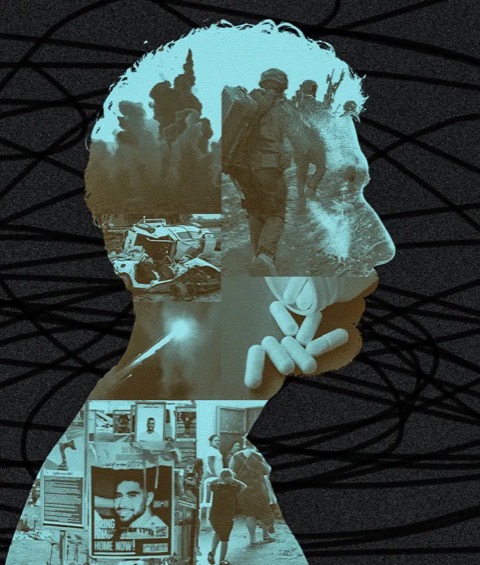
Credit: Eliahu Hershkovitz, Ilan Assayag, IDF Spokesperson, Itay Cohen. Design: Aron Ehrlich
Anxiety, sleep disorders, domestic violence, eating disorders, road accidents. Statistic after statistic reveals the unprecedented impact of the war on Israelis' mental health
Nadav Wiersch's telephone never stops ringing. "Excuse me," he says. "I can't miss a call." Some talk to him in a whisper, others anxiously.
His last caller was the wife of a reservist. "He left the house hours ago and doesn't answer his phone," she says. Wiersch went looking for him with the help of the police. After several hours, he was found in a nearby woods. Confused, angry, suicidal. If they had found him a few hours later, it might have ended differently. Another name would have been added to the lesser-known list of war casualties: those with psychological injury.
Until the war began, the man had been functioning perfectly well, working as a crane operator. He no longer does. A Defense Ministry committee ruled that he was completely unfit for employment.He went from being a tax-paying citizen and an active-duty reservist, to someone dependent, and dangerous to himself and those around him. None of his caregivers know if he'll ever return to society.
"This has become a regular occurrence," sighed Wiersch, chairman of Yahalomei Krav (Battle Diamonds), an association for war wounded. "There are many like him."
Since the start of the Gaza war, Haaretz has reported on people whose mental health has deteriorated. They describe torment, a mental pain that casts a heavy shadow on their functioning.
Readers may feel that these are extreme cases. However, the conversations that Haaretz conducted in recent weeks with mental health officials paint a different, alarming picture. "The numbers leave no shadow of doubt," says Prof. Eyal Fruchter, chairman of the National Council for Post-Trauma. "Israel faces a national crisis."
Start with the figures from the Defense Ministry. Before the war, the rehabilitation branch dealt with 62,000 injured, of whom 11,000 were dealing with mental health issues.As of last month, the numbers had shot up to 82,000 and 31,000 respectively.
However, it is not these numbers that worries the experts. "The damage that we're seeing today constitutes just a small part, even the tip of the iceberg, of what will be coming," says Prof. Zahava Solomon, a world-leading researcher in the field of trauma. "The research shows significant rates of delayed reactions. It's precisely periods of quiet that allow traumatic content to erupt. Many discharged soldiers are ticking time bombs."
The Defense Ministry doesn't try to minimize or deny the problem. Several months after the Hamas attack, the ministry invited several journalists to a briefing. "We expected that by 2030, the [Ministry of Defense's Rehabilitation Department] will be taking care of 100,000 people, 30 percent of whom are expected to be coping with mental health issues," the ministry said. Some Finance Ministry officials dismissed the claims as a means of getting more funding. They soon admitted that they were wrong.
In the past year, the rehabilitation branch has revised its forecast and now expects to reach the 100,000 figure by 2028, with the share of those dealing with mental health issues rising to half the total. More recently, it has said it expected to reach the six-digit figure by next year. Yet, even those numbers tell only part of the story. "Many don't want to be recognized by the ministry," says Wiersch.
Prof. Yair Bar-Haim, head of The National Center for Traumatic Stress and Resilience at Tel Aviv University, knows people like that. "In our clinic, we've taken care of hundreds of reservists with obvious symptoms, who without a doubt are eligible for recognition by the rehabilitation department, but don't want to deal with all the bureaucratic complications."
Others, says Wiersch, are afraid of the consequences of recognition, such as having their driver's licenses or gun taken away, or not being able to find work in the defense system. And there are others who are simply embarrassed. "Mainly older people or those dealing with 'moral injuries.' They're afraid of being judged, of being called traitors."
Everyone's in an at-risk group
If this were a war like all wars, military forces would be the lion's share of psychological casualties. But this war is different, more complex. Civilians are not only watching the war from afar, in the background: The horrors have reached the home front, leaving civilian victims with physical and mental challenges. They include residents of the Gaza envelope, Nova victims and those whose homes were hit by an Iranian missile. As the war continues, the circle of casualties grows.
On the eve of October 7, the number of citizens injured in hostile acts and recognized by the National Insurance Institute as disabled due to mental health issues was at 6,412. This week, the number of those recognized by the Institute as having mental injuries reached more than 69,000, with about 35,000 of them having already undergone committee review and been recognized as disabled. Thus, in less than three years, the number has jumped by more than tenfold.
"Everyone's talking about the wounded soldiers, but what's happening over here is simply insane," says a senior official at the National Insurance Institute, "Even in the most severe extreme scenarios, we couldn't have imagined such numbers."
Additionally, these numbers, explains Prof. Yossi Levi-Belz, don't adequately represent the intensity of mental pain that Israeli citizens have faced in the last three years. According to him, public and clinical discourse often focuses on people diagnosed with post-traumatic stress disorder after meeting specific diagnostic criteria. However, a longitudinal study he's leading found that the number of Israelis who exhibited PTSD symptoms during the war is much higher. Levi-Belz, head of the Lior Tsfaty Center for Suicide & Mental Pain Studies at Ruppin Academic Center, began the study for a completely different reason: the judicial overhaul.
- War has triggered clinical mental illness in millions of Israelis Gid'on Lev
- Military suicides surge as IDF scales back mental health support Tom Levinson
- IDF withholds data on mental health discharges despite legal obligation Tom Levinson
About a month before the war, he found that the rate of PTSD symptoms in the population was about 16 percent; a month after October 7, it jumped to about 30 percent; and two years and three months later, it was about 19.7 percent. "This is significantly higher than the global rate," Levi-Belz says. The World Health Organization, for example, found in 2021 that the global rate of people who experienced post-trauma symptoms was about 3.9 percent.
Levi-Belz also found that some populations are at a much higher risk of developing symptoms than the general population. For example, compared to the general population, reservists have 2.57 times the risk, those directly exposed to the horrors of October 7 have 3.3, and those who lost a loved one in the war have 1.6. Arabs have four times the risk of Jews.
However, when examining Israeli society from a macro perspective, Levi-Belz says, it's clear that all of us are, to some extent, in a risk group.
"In professional terms, this is called 'collective trauma' – a difficult event that affects us not only as individuals, but also as a community, as a society, as a state," he explains. The October 7 massacre and the war that followed, he says, are intertwined with our social structures, our identity and our interpersonal relationships. "Israeli society is exhausted, feeling a sharply intense burnout. It's grappling with moral questions, with a sense of betrayal by the state and its leaders."
Collective trauma, Levi-Belz continues, "is insidious; it doesn't stop you like PTSD. Sometimes people seem fine, even too fine, going out and socializing. But can't forget that it's not over; it's not just the outward appearance [that matters]. The questions gnaw at them [from inside], the fears."
According to him, the choice, sometimes conscious, of leaders in Israel to deny or downplay the mental pain and collective anxiety of the public leads to denial, and sometimes even shame, among those who suffer. "In such a situation, everything seems okay, but then [PTSD] erupts in other places. The amount of honking and road rage on the road, for example, is a snapshot of the water boiling beneath the surface of Israeli society."
Crying out for help
And sometimes, the water comes to a boil. During the war, there was a surge in traffic fatalities – from 361 in 2023, to 439 in 2024, to 459 in 2025. On the surface, these figures have no connection to the war. However, some of the experts who spoke with Haaretz explained that, according to a consensus in research literature, people experiencing post-traumatic symptoms tend to exhibit problematic driving patterns more frequently than that of the general population. A sharp increase was also recorded in 2007, after the Second Lebanon War, when 437 people were killed in road accidents – an exceptionally high number compared to the years before and after it.
The war's effects are not only evident on the roads. A report by the National Council for the Child, for example, found that the number of new anxiety diagnoses among adolescents (ages 12 to 17) in the second year of the war (October 2024 to October 2025) was 31 percent higher compared to the year before the war. The number of new eating disorder diagnoses in this age group also rose by about 23 percent compared to the situation in the year before the war.
A report by the Women's International Zionist Organization found a 65 percent increase of domestic violence in Israel's general population in the first six months of the war, compared to the corresponding period in the year before it – 4,566 calls to its shelters compared to 2,760. A 2024 study found an eight times higher chance of physical or sexual violence at home when both partners are serving in the reserves.
According to experts, the war is also having a significant negative impact on the quality of sleep of Israelis. A study by Hebrew University's School of Medicine found that before October 7, 5 percent of the population in Israel suffered from clinical insomnia (1 percent severe, and 4 percent moderate). By the end of 2025, the rate reached 28 percent: 7 percent severe and 21 percent moderate.
"When I lecture to people, I ask the audience, who here slept seven consecutive hours last night, who had good and refreshing sleep? Out of an audience of 200 people, maybe three raise their hand," illustrates Prof. Gil Saltzman, one of Israel's leading psychiatrists. "This is not surprising; we live in a state of uncertainty. The phone might ring again in an hour, and missiles from Iran could be launched. We're in survival mode – and this has consequences."
Mental health professionals in psychiatric hospitals are intimately familiar with these consequences; they experience them daily in psychiatric hospitals, far from public view. "Since October 7, there has been a 30 percent to 40 percent increase in the number of Israelis seeking treatment for the first time at the hospital's outpatient clinics," says Saltzman, head of the Children and Youth Department at Geha Mental Health Center. "This is a dramatic figure," he says, "people don't rush to psychiatric hospitals; it's a sign that they are desperate, that they are crying out for help."
'The research shows significant rates of delayed reactions. It's precisely periods of quiet that allow traumatic content to erupt. Many discharged soldiers are ticking time bombs.'
The call for help is also evident in the results of a large-scale survey conducted by Maccabi Health Services, a major healthcare provider, which examined the rate of Israelis who feel they need mental health assistance. It was at 18 percent a month into the war, 25 percent 6 months into the war, and reached 32 perfect by the end of 2025.
A Health Ministry report published last month also showed a significant increase in the number of referrals to community resilience centers, which provide psychological and organizational support to Israelis in crisis situations. According to the report, the number of people treated in the centers jumped from 5,000 in 2022, to 36,000 in 2025. The report also indicated that use of certain mental health medications has jumped, describing a 16.7 percent increase in sedatives, and a 14 percent increase in anti-depressants and sleeping pills.
Many Israelis are seeking alternative methods of coping, with consequences. A report published by the Israel Center for Addictions and Mental Health in June 2025 found that, during the war, one in four Israelis has been using alcohol, cannabis, prescription sedatives or painkillers at an increased risk level. Before the war, the rate was one in seven. Among those reporting significant PTSD symptoms, the rate jumps to 54.2 percent.
"This is a severe blow," says Wiersch. "I visit wounded people and see insane amounts of cocaine, people finishing whole bottles of vodka to get through another day, some even falling into heroin and other hard drugs, from which there's no return. There were always cases like these, but they were fringe. Now it's everywhere."
'Israeli society is exhausted, feeling a sharply intense burnout. It's grappling with moral questions, with a sense of betrayal by the state and its leaders.'
Prof. Solomon is also particularly concerned about the massive use of drugs and alcohol among the recently wounded. "In the period after the Yom Kippur War, this was a marginal phenomenon, affecting only a few," she explains. "Today, access to drugs and alcohol is much higher, and this greatly affects consumption, even decades after the fact. When American soldiers were in Vietnam, they consumed quantities of mind-altering substances to dull the pain, and when they returned to the U.S., they didn't stop; the opposite happened. They tried to mask their feelings, and hid a lot of pain underneath drugs."
This sort of grief can end in death. In the last few years, there have been highly public cases of suicide by discharged soldiers who were unable to cope the mental pain caused by their military service. More families of suicide victims have been breaking the silence since October 7, and not without reason. While there's no noticeable increase in suicides among the general public during the war, it's present among former soldiers. The Ministry of Defense's Rehabilitation Department recorded six suicides in 2024, and in 13, 2025. However, suicides tend to increase more drastically, Prof. Fruchter says, after the fighting is over, when wars end. He predicts an increase of 20-30 percent.
The increase in suicides isn't just worrying experts – veterans with PTSD are also highly concerned, including veterans of the Second Lebanon War (2006), the Second Intifada (2000-2005), and even the Yom Kippur War (1973). Last July, a group of veterans gathered outside the Rehabilitation Department branch in Petah Tikva, chanting "PTSD veterans are stopping the next suicide" over and over.
One of the veterans at the protest, Or Aflalo, had been traumatized only recently, in fighting in the Gaza Strip. He also didn't need media reports to realize the rise in veteran suicides – he was intimately familiar with the issue. His brother in-law, Eliran Mizrahi, operated a Caterpillar D9 armored bulldozer in Gaza, returned home with a severe mental injury, and was diagnosed with PTSD. In June 2024, two days before he was supposed to return to combat, he took his own life. "I'm here to request that the state make sure there won't be any more cases like Eliran's," Aflalo told Haaretz. "It's our duty – all of society's duty – to help people before they fall into the abyss, before we lose them."
Some of the protestors spoke, almost in whispers, about about another phenomenon besides suicide: fatal overdoses by the mentally disabled. Haaretz tried unsuccessfully to obtain data on this issue over the past year. Sources in the Defense Ministry admitted that they had identified an increase in the phenomenon in the last few years. "The public remains completely unaware of these cases," one of them said. "These people die quietly, in silence."
Last February, Aflalo was found lifeless in his home. He was 24 years old. The cause of death was an overdose.
770 patients per worker
It was a turbulent time. The Netanyahu government was racing unchecked towards a judicial overhaul. Some chanted in the streets and blocked roads, while others began planning backup plans for their futures.
During that time, a British headhunter arrived in Israel. He wasn't recruiting for Chelsea football club, nor a high-tech firm. Instead, he was searching for psychiatrists. "He arranged for U.K. work permits, helped them sell homes, and all the logistics of relocating," Saltzman recounted. The result? "Ten senior psychiatrists moved to Bristol."
They weren't the only ones. According to Prof. Fruchter, dozens of psychiatrists left Israel during the war. "Many of them say they're going on sabbatical, but they just don't come back," Saltzman explains. "They're in New Zealand, Canada, and the U.S., and when you talk to them, you realize: they're not coming back."
According to experts, the situation gets even worse when you take into account the fact that Israel was grappling with a severe shortage of mental health professionals even before the war. "The state began the war with about 270 vacant public service psychiatrist positions," Fruchter says. "There's a total of about 1,000 psychiatrists in Israel, and more than 50 percent are over the age of 56. In a good year, we certify about 40 new specialists, and maybe 35 of them will stay in the country. That means that, each year, there's less entering the profession than leaving it."
Patients are paying the price. "There are dozens of psychiatric departments in Israel with just a single doctor; in Israel's north, there are even doctors managing two departments at the same time," Saltzman says. The demand is so high that it's sometimes difficult to decide where they're most needed, he says.
"I used to sit with [Director-General of the Ministry of Health] Moshe Bar Siman Tov and argue with him over every single psychiatrist," a former senior official at the Rehabilitation Department says. "How are you even supposed to decide [something like] if a psychiatrist is more needed in a committee for determining disability level for a PTSD sufferer, or in an eating disorder department?"
The shortage of mental health professionals is not limited to psychiatrists; it exists across the entire spectrum of care. "As of today, there's a shortage of about 500 psychologists against vacant positions in the public service," says Fruchter. "There's also a severe shortage of social workers." Currently, the Rehabilitation Department has 113 rehabilitation workers, and they're responsible for realizing the rights of about 87,000 wounded and disabled individuals, meaning each worker is responsible for about 770 patients.
"I've got to tell the truth, there are patients I haven't even spoken to once," one of the Defense Ministry workers told Haaretz. "Even if I wanted to send a message to each patient once a month, I couldn't; I simply don't have the time. Every morning, I have to decide on whether it's more important to treat a patient who lost a leg in Gaza or a post-trauma sufferer who wets the bed. It's an impossible task; I'm doomed to fail before I even start my workday."
Last year, the Ministries of Defense and Finance launched the Mor-Yosef committee to expand services for the IDF wounded, addressing, among other things, the critical lack of mental health professionals. A draft of one of the committee's conclusions, which reached Haaretz, recommended that the Defense Ministry work to reduce the ratio of rehabilitation workers to patients to 1:50. However, the recommendation was ultimately dropped from the official report.
"Even if they come and say, 'let's add 600 social workers to the Defense Ministry right now,' where would you get them from? There's nowhere to get these people from," Saltzman says. Instead, the committee recommended recruiting 'personal connection women,' who aren't social workers, and whose role would be to assist patients realize their rights. Social workers, according to the recommendations, would instead be responsible for more complex issues, such as driving patients' rehabilitation process and integrating them into employment and education. For now, the recommendation, like many others, remains on paper.
Meanwhile, the number of patients continues to grow, and the government isn't finding any solutions. "The burden only increases, and the burnout is immense," says Saltzman. "Experts are abandoning public service, one after another." The shortage, according to experts, is not only in medical health professionals. It even applies to emotional support dogs, hospital beds, and balancing homes (a form of halfway house for those in acute mental distress).
Fruchter, who also serves as chairman for Israel's Collective Action for Resilience, an NGO, emphasizes that a comprehensive, system-wide approach is required to address the issue. "A lot of organizations are being created, and no one knows how to guide them from above. There also isn't enough communication between the various public and semi-public agencies involved, such as the Health Ministry, Defense Ministry, National Insurance Institute, and health care providers. An inter-ministerial committee on this issue needs to be established. In a perfect world, this issue should have been at the top of candidates' election platforms, but the government chooses to look away. It'll explode on us in the future like a very powerful bomb. There will be unprecedented consequences – in academia, the labor market, and the entire Israeli economy."
A report in January by NATAL, an NGO, for example, estimated the damage to the economy at 100 billion shekels ($33.44 billion) per year. 40 billion is the direct cost of impaired work capacity for hundreds of thousands of people, as well as their treatment costs. The other 60 billion is the indirect cost of associated phenomena, such as an increase in accidents, violence, addictions, and serious illnesses.
Another example of the massive cost is the Rehabilitation Department's budget, which jumped from 5.2 billion shekels before the war, to 10 billion this year. Defense and Finance Ministry officials are expected to wage a fierce battle soon over billions in additions to the budget. According to the Finance Ministry, every day of fighting incurs additional costs, which will make marks on the budget for many years to come.
"I have many recommendations I could give to decision-makers," Prof. Bar-Haim said, "but it seems that there's one that tops any other: we must strive to end the war. I'm not a diplomat or a military man, but I can say that, there are military, economic, and social reasons behind relatively short wars, but there also psychological reasons.
"A year and a half ago, we examined a very large sample of reservists who participated in the war, and found a significant PTSD rate of 12%. Among American soldiers who stayed in Iraq and Afghanistan for years, it reached 15%, and at one point even 19%. It's not without a reason," Bar-Haim said. "Every round of combat produces thousands of newly wounded, and repeated traumatic events weaken individuals. Every time a reservist goes on another round, his mental resilience is [further] eroded – the wall cracks. Even if it didn't happen in the first few rounds, it could happen in the sixth or seventh."